SITE 7: COURTHOUSE SQUARE: HURON and MAIN
Sponsored by First Martin Corporation
Photos Courtesy of the Bentley Historical Library and collection of H. M. Hildebrandt
|
Click within the image below for a closer look
|
|

SITE 7: COURTHOUSE SQUARE: HURON and MAIN
Sponsored by First Martin Corporation Photos Courtesy of the Bentley Historical Library and collection of H. M. Hildebrandt
|
Click within the image below for a closer look
|

Panel Information: From Interurbans to Buses
In 1929 long-distance buses replaced the electric interurban for travel between Ann Arbor and other cities. The first interurban in the state had linked Ann Arbor and Ypsilanti in 1891. Junius Beal, UM Regent and one of the main stockholders, explained that it was greatly helped by the fact that “Ann Arbor had 3,000 boys and not enough girls; Ypsilanti had 1,000 girls at the Normal College [now EMU] and not enough boys.” Interurbans ran east on Packard to Detroit and west on Huron to Jackson every half hour or hour.
The era of the interurban ended due to com- petition from buses, autos, and trucks. Interstate buses used the old interurban station until it was demolished in 1939 and a modern bus depot built in 1940.
Production and Installation Sources
Ray Detter, Coordinator
120 N. Division, Ann Arbor, MI 48104
Phone: 734-668-7027
Email: rdetter@umich.edu
Carl Luckenbach, Project Architect
Luckenback-Ziegelman, Architects
255 East Liberty, Ann Arbor 48104
Phone: 734-997-9444
Don Hammond, Project Designer
Hammond Design
301 Wilton St., Ann Arbor 48103
Phone: 734-604-2811
Joe O’Neal, Engineering and Installation
O’Neal Construction, Inc.
525 W. William, Ann Arbor 48103
Phone: 734-769-0770
Glass Panel Manufacturers
Imaging Sciences
38174 Willoughby Parkway
Willoughby, Ohio 44094
Phone: 440-975-9640
Fax: 440-975-9657
Email: sales@imaging-sciences.com
Website: www.imaging-sciences.com
Glass Installers
Calvin & Co., Inc.
3100 Airport St.
P.O. Box 7435, Flint, MI 48507
Phone: 810-239-3324
Porcelain Enamel Images
Winsor Fireform
3401 Mottman Road, S.W.
Tumwater, Washington 98512
Phone: 800-824-7506
Stainless Steel Frames
Special Fabricators
31649 Stevenson Highway
Madison Heights, MI 48071
Phone: 248-588-6717
Recognition Plaques, Bronze Artifacts
W.A.P. John at Grafaktri, Inc.
1200 N. Main, Ann Arbor 48104
Phone: 734-662-3902
SITE 12: WALL DISPLAY : Uptown Theaters
Sponsored by Ralph P. Beebe, Pauline V. Walters, and First Martin Corporation
Photos courtesy of the Bentley Historical Library
|
Click within the image below for a closer look
|
|

SITE 12: WALL DISPLAY : From Liveries to Taxis
Sponsored by First Martin Corporation
Photos Courtesy of the Bentley Historical Library
|
Click within the image below for a closer look
|
|

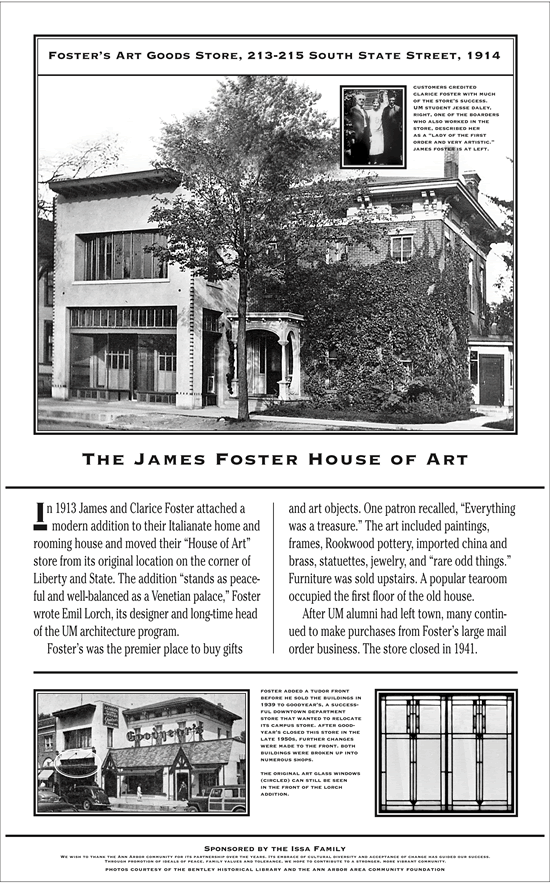
SITE 12: WALL DISPLAY : The James Foster House of Art
Sponsored by the Issa Family
We wish to thank the Ann Arbor community for its partnership over the years. Its embrace of cultural diversity and acceptance of change has guided our success. Through promotion of ideals of peace, family values and tolerance, we hope to contribute to a stronger, more vibrant community.
Photos courtesy of the Bentley Historical Library and the Ann Arbor Area Community Foundation
|
Click within the image below for a closer look
|
|
Anal Shah at the 45th Ann Arbor Film Festival

Year:
2007
- Read more about Anal Shah at the 45th Ann Arbor Film Festival
- Log in or register to post comments
Map of the Broadway Bridge Exhibits
 |
 |
SITE 10a. BROADWAY BRIDGE at entrance to Broadway Park
Lower town, transportation, town and gown.
SITE 10b. BROADWAY at SWIFT: east side at north end of bridge
Lower town, transportation, town and gown.
SITE 10: Broadway Bridge Porcelain Display : Along the Michigan Central Railroad Tracks
Sponsored by First Martin Corporation
Photos Courtesy of Bentley Historical Library
|
Click within the image below for a closer look
|
|
