Panel Information: Lower Town's Flour Mills
On the site in front of you in 1860, William Sinclair built the flour mill shown above in the birdseye on right. Lower Town founder Anson Brown had erected the first mill here in 1833. Brown dammed the Huron River up-stream to create a millpond and raise the level of the water, which flowed down a millrace high above the river's north bank. This provided power for the flour mill, a woolen mill, a paper mill, and other Lower Town industries.
Hydro power uses the energy of flowing water to do work. Water falling from a headrace creates enough force to turn the blades of the water wheels in the mill, before flowing out a tailrace to the river below. Main drive shafts transfer power from water wheels to a series of gears, shafts, pulleys, and belts that operate millstones, sifters, grist elevators,grain cleaners, and other equipment.
Sinclair’s earlier mill on this site was reported to have ground 800 barrels of flour weekly. Following the 1841 harvest, it shipped a record 8,112 barrels to New York via the Erie Canal. Under subsequent owners, the mill retained Sinclair’s name. In 1894 the Ann Arbor Milling Company renamed it Argo Mills.
Panel Information: From Industry to Parks
Alber & Co., one of the city’s earliest blacksmith and wagon shops, once stood in front of you where State Street ended at Broadway after crossing the railroad. Factories, mills, slaughterhouses, and tanneries operated nearby as well as three spring-fed breweries. The Northern Brewery on Jones Street advertised “bottled beer in cases of 2 dozen or 1 dozen bottles, quart or pint, delivered to any part of the city.” The spring was later tapped by the Arbor Springs Water Company. After the brewery closed in 1908, the building was used as a foundry for fifty years. It was renovated for offices in 1976.
Panel Information: The Agricultural Works and Lower Town
In 1866 Lewis Moore and his son Eli began building an agricultural implement factory on the north bank of the river on the site of an old paper mill. By 1896 the Ann Arbor Agricultural Works, seen above in a fanciful drawing, covered three acres. It was one of the largest employers in town with a machine shop, warehouse, lumber yard, and its own railroad spur. The machinery was powered by water from the millrace, later supplemented by steam. The headrace ran under Broadway and the tailrace flowed out next to the foundry.
Sixty-five men manufactured a line of horse-drawn agricultural implements including "the Advance Hay Tedder, Advance Iron Mower, the Advance Sulky Rake, the Columbia Hay Press, the Advance Chilled Plow, and the Improved Cummings and Clipper Feed Cutter.” The company claimed a reputation for “first class goods in this line.” Eli Moore was the plant’s supervisor until 1903, when the business became the Ann Arbor Machine Company, manufacturing many of the same products. Edison acquired the property and built a warehouse on the site in 1928.
Panel Information: The Clairvoyant Physician
In 1865 Lower Town's most unusual citizen, Dr. Daniel B. Kellogg, a "clairvoyant physician," purchased the building to your right which then had four stories. Kellogg was a medium who performed his medical wizardry by "communicating" through the disembodied spirits of two Native American medicine men, Walapaca and Owosso. During trances, Kellogg claimed to see patients’ internal organs in glowing electric tints. Letters arrived from all over the country seeking his aid. All that was needed for a mail order diagnosis was the patient's name, age, address—and the usual fee. To answer the demand for Daniel’s cures, he and his brother Leverett marketed a line of family medicines, which included Kellogg's Liver Invigorator and Kellogg’s Magic Red Drops. After Daniel died in 1876, Leverett continued the patent medicine business. Daniel’s son Albert served as the new medium.
Panel Information: The Underground Railroad
Rev. Guy Beckley was a “conductor” on the Underground Railroad, even though it was a federal crime to help escaping slaves. His house nearby on Pontiac Trail was one of several secret "stations" in the area. Caroline Quarlls, who escaped from slavery, stayed with Beckley on her journey to freedom in Canada. Michigan’s Anti-Slavery Society was established in Ann Arbor in 1836. Starting in 1841, its newspaper, The Signal of Liberty, which called for the abolition of slavery in the United States, was published in the Huron Block, directly across Broadway from here, by Beckley and his co-editor Theodore Foster. Beckley died in 1847.
SITE 10b. BROADWAY at SWIFT: east side at north end of bridge
 |
** |
PORCELAIN EXHIBIT PANELS:
- The Underground Railroad
- The Clairvoyant Physician
- The Agricultural Works and Lower Town
- From Industry to Parks
- Lower Town's Flour Mills
- Early Power and Transportation
- The Finest on the Line
- Along the Michigan Central Railroad Tracks
Photos Courtesy of the Bentley Historical Library
|
Click within the image below for a closer look
|
|

SITE 10a. BROADWAY BRIDGE at entrance to Broadway Park
 |
** |
Photos Courtesy of Wystan Stevens and the Bentley Historical Library
|
Click within the image below for a closer look
|
|
Panel Information: Lower Town
In 1832, New York native Anson Brown erected the Exchange Block in which was called Lower Town. He was determined to make this side of the river Ann Arbor's center. Where the Potawatomi Trail crossed the Huron River, a wooden bridge had been built in 1828 to carry traffic from Detroit and Pontiac to the village of Ann Arbor. Brown and his partners dammed the river upstream and built a flour mill next to the bridge, where Edison later built the substation to your left.
The partners laid out streets with New York City names: Broadway, Maiden Lane, Canal, and Wall. Brown succeeded in capturing the appointment of postmaster, forcing upper-village "Hill-Toppers" to come to Lower Town for their mail. His ambitious dreams died with him in the cholera epidemic of 1834, but Lower Town survived as a distinct neighborhood with its own school, industry, and commercial center. It was incorporated into the city as the fifth ward in 1861. Workers as well as business owners lived in homes that still remain on Broadway, Pontiac, and Traver.
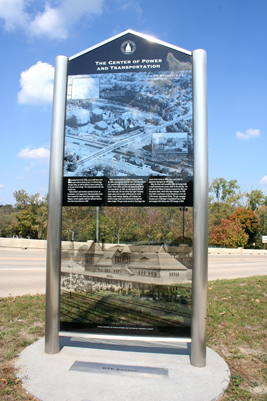
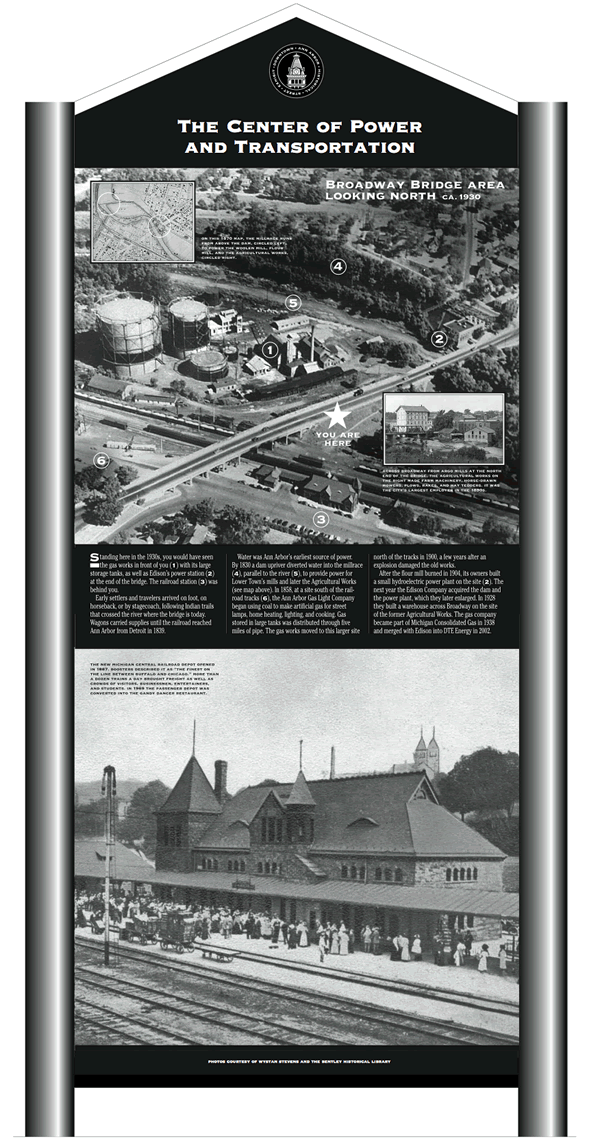
Panel Information: The Center of Power and Transportation
Standing here in the 1930s, you would have seen the gas works in front of you with its large storage tanks, as well as Edison's power station at the end of the bridge. The railroad station was behind you.
Early settlers and travelers arrived on foot, on horseback, or by stagecoach, following Indian trails that crossed the river where the bridge is today. Wagons carried supplies until the railroad reached Ann Arbor from Detroit in 1839.
Water was Ann Arbor's earliest source of power. By 1830 a dam upriver diverted water into the millrace, parallel to the river, to provide power for Lower Town's mills and later the Agricultural Works. In 1858, at a site south of the railroad tracks, the Ann Arbor Gas Light Company began using coal to make artificial gas for street lamps, home heating, lighting, and cooking. Gas stored in large tanks was distributed through five miles of pipe. The gas works moved to this larger site north of the tracks in 1900, a few years after an explosion damaged the old works.
SITE 9: WALL DISPLAY : Industry on Detroit Street
Sponsored by The Treasure Mart
Photos courtesy of the Bentley Historical Library
|
Click within the image below for a closer look
|
|
