SITE 7: COURTHOUSE SQUARE: HURON and MAIN
Sponsored by Cappy Bilakos
Photos Courtesy of the Bentley Historical Library
|
Click within the image below for a closer look
|
|

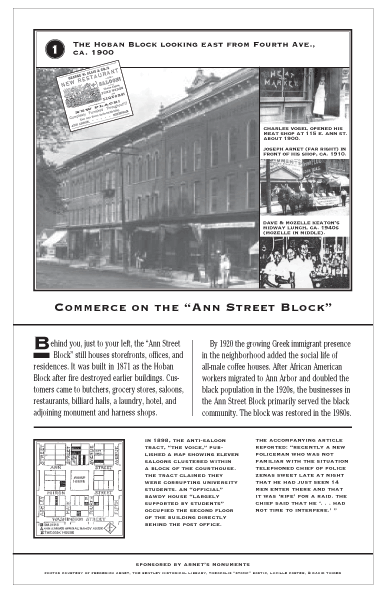
Panel Information: Commerce on the "Ann Street Block"
Behind you, just to your left, the "Ann Street Block" still houses storefronts, offices, and residences. It was built in 1871 as the Hoban Block after fire destroyed earlier buildings. Customers came to butchers, grocery stores, saloons, restaurants, billiard halls, a laundry, hotel, and adjoining monument and harness shops.
By 1920, the growing Greek immigrant presence in the neighborhood added the social life of all-male coffee houses. After African American workers migrated to Ann Arbor and doubled the black population in the 1920s, the businesses in the Ann Street Block primarily served the black community. The block was restored in the 1980s.
SITE 7: COURTHOUSE SQUARE: HURON and MAIN
Sponsored by Arnet's Monuments
Photos Courtesy of Frederick Arnet, The Bentley Historical Library, Theopolis "Stomp" Bostic, Lucille Porter, & David Tinder
|
Click within the image below for a closer look
|
|
Panel Information: The Streets Around Courthouse Square
For over one hundred years the streets surrounding Courthouse Square were a focus for busy Ann Arbor life. Most structures that housed the many businesses and activities around the square are gone. No photo exists of Miss Monroe's primary schoolhouse, a crude log building with small glass windows and split log benches. It stood behind you on the northwest corner of Main and Ann Streets from 1825 to 1829, at a time when the square served as town founder John Allen's vegetable patch and members of the Potawatomi tribe traded berries in town.
SITE 7: COURTHOUSE SQUARE: HURON and MAIN
Sponsored by The Washtenaw County Bar Association
Portrait from the History of Washtenaw County
|
Click within the image below for a closer look
|
|

Panel Information: Shopping on East Huron Street
Advertising signs and cards display the wide variety of goods offered in the 1870s by the businesses pictured above. The plank sidewalk, gas lanterns, and dirt road have long since been replaced by concrete, bright lights, and blacktop. All the buildings east to Fourth Ave., including the imposing Cook House Hotel, are gone.
But in the block beyond, some remain behind façades that reflect changing needs and styles over time. The brick building on the corner of East Huron St. and South Fourth Ave. where Caspar Rinsey sold groceries, has long been hidden behind painted aluminum siding.
SITE 7: COURTHOUSE SQUARE: HURON and MAIN
Sponsored by Kleinschmidt Insurance
Photos Courtesy of the Bentley Historical Library
|
Click within the image below for a closer look
|
|

Panel Information: Main Street in the 1890s
When this photo was taken in 1893, "Lost in New York" was playing at Hill's Opera House at the southwest corner of Main and Ann Streets. Down the block, Charles J. Shetterly, barber, offered billiards and hot and cold baths, and students and towns people shopped at George Wahr's popular bookstore.
Other attractions on the block included the Palace Grocery, Singer Sewing Machines, two saloons, one confectioner and fruit dealer, two more billiard halls, a milliner, the Ann Arbor Argus newspaper office, and Francis Stofflet's magazine store. None of these buildings remain.
SITE 7: COURTHOUSE SQUARE: HURON and MAIN
Sponsored by Charlotte and George Wahr Sallade
Photos Courtesy of the Bentley Historical Library
|
Click within the image below for a closer look
|
|

Panel Information: Departing Heroes and the Home Front
Little more than four weeks after the sinking of the battleship Maine, volunteers in Company A of the Michigan National Guard posed on the courthouse steps on April 26, 1898, before leaving to fight in the Spanish-American War.
Although Company A saw no combat in Cuba, they were nonetheless greeted as heroes on their return to Ann Arbor in May 1899. Citizens raised $3000 toward the purchase of a local armory as a gift to them, and city council appropriated $300 to buy medals for all who had served in the war.
Like virtually every other American city,town, and village, Ann Arbor sponsored recycling campaigns during World War II to gather valuable materials for the war effort. Rubber tires, motor oil, and metal were just some of the materials gathered.
Months before the formal entry of the U.S.into the war in 1941,bins were erected on Courthouse Square for the collection of aluminum, a critically important resource in industrial war production.